

Everything you need to know about the legal side of things
VSO settlement agreement
Strengthen your position with my advice




More than 10 years of experience
VSO settlement agreement
95% certainty on better severance scheme
Personal advice tailored to your situation
Free VSO check: advice within 30 minutes

What is a settlement agreement (VSO)?
A settlement agreement, or a termination agreement, is drawn up if your employer wishes to terminate and rescind your employment contract. This agreement may also be an option if your employer wishes to terminate your current fixed-term contract before it expires.
This form of resign is done by mutual agreement, without the intervention of the UWV Whether the cantonal court. The agreement contains all the agreements made during this process. Think about the end date of your employment, the notice period, the reason for leaving and whether you are entitled to a fee.
A free VSO check in 3 steps
Why is the VSO check free?
A settlement agreement can have significant consequences for your income and your entitlement to unemployment benefit. That is why we offer a free settlement agreement check. This helps to make it easier for you to seek advice in good time.

Fast forward to
- When will you get a settlement agreement?
- How does a dismissal settlement agreement work?
- Benefits of settlement agreement
- Disadvantages of a settlement agreement
- What does a settlement agreement contain?
- What is the notice period for a VSO?
- What is the cooling-off period in a settlement agreement?
- Am I entitled to a transition payment if I am on a VSO?
- Further information on settlement agreements
- How I can help you
- I’ll be happy to help you with honest advice
- Frequently asked questions about settlement agreements
How does a dismissal settlement agreement work?
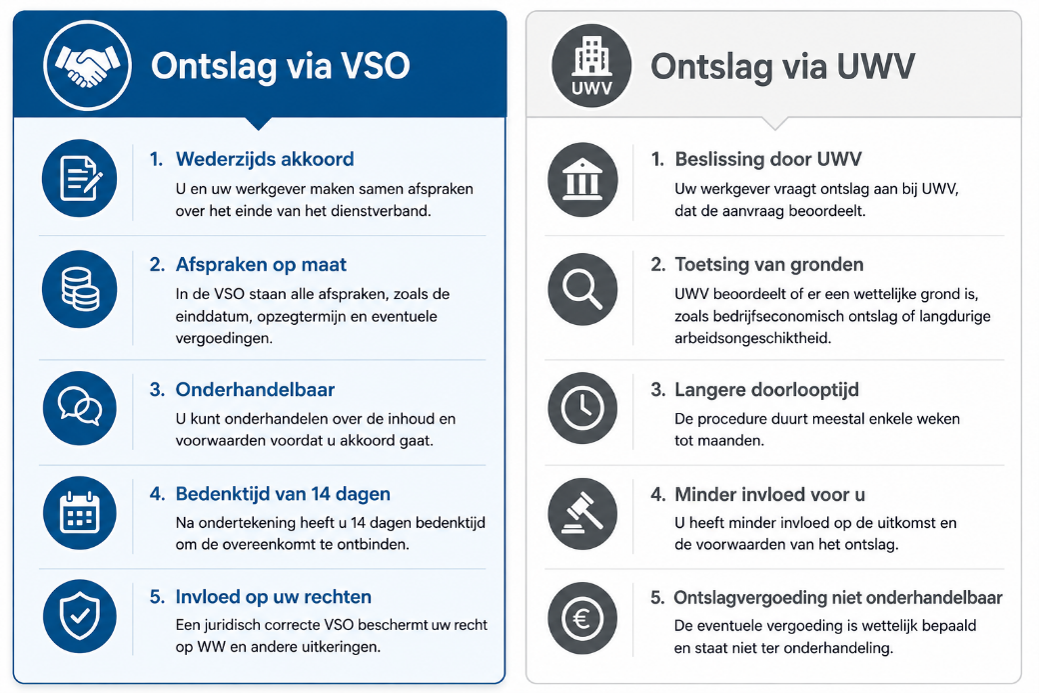
In the event of termination by mutual consent, the employer usually draws up a settlement agreement. This sets out all the arrangements regarding the end of the employment relationship, such as the last day of work, the notice period, any payments due and the entitlement to unemployment benefit. Once you have received the proposal, you can read it through at your leisure and, if necessary, negotiate its terms.
The agreement is only signed once both parties have given their consent. From that moment, a statutory cooling-off period of 14 days applies. It is important that the agreement is drawn up in a legally correct manner; otherwise, this could have consequences for your unemployment benefit entitlements, for example. You should therefore always have the content checked by a lawyer before signing.
Benefits of settlement agreement
U voorkomt een langdurige procedure via het UWV of de rechter.
U heeft invloed op de inhoud van de afspraken.
Er is ruimte om te onderhandelen over een ontslagvergoeding.
U kunt afspraken maken over de einddatum en opzegtermijn.
De overeenkomst geeft duidelijkheid voor beide partijen.
Bij een correct opgestelde VSO behoudt u het recht op een WW-uitkering.
U heeft standaard 14 dagen bedenktijd na ondertekening.
In veel gevallen vergoedt de werkgever (deels) de kosten voor juridisch advies.
Disadvantages of a settlement agreement
Zonder goede controle kunnen afspraken ongunstig voor u uitpakken.
Bij een fout in de formulering loopt u mogelijk uw recht op een WW-uitkering mis.
De druk om snel te tekenen kan ten koste gaan van een eerlijke regeling.
U moet zelf actief actie ondernemen om uw belangen te beschermen. Wij helpen u daar graag bij.
Zonder goede controle kunnen afspraken ongunstig voor u uitpakken.
Als u ziek bent, is een vaststellingsovereenkomst vrijwel nooit verstandig. U heeft ontslagbescherming én verliest bij ondertekening mogelijk uw recht op een WW-uitkering.
What does a settlement agreement contain?
You have agreed, after mutually agreeing to terminate the employment contract, to draw up a settlement agreement. What does this look like and what information should it contain? We list them for you:
- Name and address employee.
- Name and address of employer.
- That the initiative for dismissal came from the employer and not the employee.
- That there are no grounds for summary dismissal.
- That this is a termination by mutual consent.
- The termination date, i.e. the end date of the employment contract (respecting correct notice periods).
- The height of the severance or transitional allowance; this amount you determine together.
- Betaling van alle openstaande vakantierechten (vakantiedagen, verlof).
- Final settlement (including settlement of any thirteenth month), so that no amount is outstanding after this.
- Possible exemption from work and agreements on transfer of work.
- Place and date of signing settlement agreement.
- Employee has two weeks reflection period after the settlement agreement is drawn up. If the agreement does not state this, the reflection period is three weeks.
In addition to these sections, you may wish to include provisions regarding non-competition and non-solicitation clauses, as well as a confidentiality agreement. Be sure to include legal costs in the settlement agreement, so that the employer covers the costs you incur for advice on the settlement agreement.
What is the notice period for a VSO?
In the case of a settlement agreement, you and your employer agree together on when the employment contract will end. In this case, there is no statutory notice, but it is important that the agreed notice period corresponds to the statutory notice period that your employer would normally be required to observe. If you fail to do so, you run the risk of the UWV (temporarily) rejecting your claim for unemployment benefit because you left your job too early. A correct notice period is therefore not just a formal agreement, but is also crucial for maintaining your entitlement to benefits. Are you unsure whether the notice period in your contract is correct? If so, have a lawyer review it before you sign.
What is the cooling-off period in a settlement agreement?
- Standard settlement agreement: 14-day cooling-off period. This statutory cooling-off period applies to every employee who signs a VSO. You do not need to give a reason for this, nor do you need to ask your employer’s permission. All you need to do is notify them in writing that you are withdrawing from the agreement.
- Settlement agreement without a specified cooling-off period: The cooling-off period is automatically extended to 21 days.
Am I entitled to a transition payment if I am on a VSO?
When dismissed via a settlement agreement, in most cases you are entitled to a transition allowance. This allowance is intended to financially cushion the transition to another job. In a VSO, the amount is usually included as part of the agreements. Pay close attention to whether the amount is correct and set according to the legal calculation. Sometimes an employer tries to come up with a lower amount than you are entitled to. Therefore, always have the amount of the compensation checked to make sure you get what you deserve.

How I can help you
How I can help you


My initial advice is free
I’ll be happy to help you with honest advice
My name is Robin Sieverdink, employment lawyer and specialising in
Settlement agreements and dismissal cases. Receiving a settlement agreement often raises questions. Is the proposal fair? Will you still be entitled to unemployment benefit? And can you still negotiate better terms?
It is precisely at that moment that it is important to get clarity. I will carefully assess your settlement agreement, looking not only at its legal content but also at the implications for your income, entitlement to benefits and negotiating position.
Would you like to know where you stand before you sign? Call or send a WhatsApp message via +(31) 085-08 054 82 or send an e-mail to info@legalworx.nl.
Frequently asked questions about settlement agreements
