
More than 10 years of experience
Relationship clause
for permanent positions, fixed-term contracts and self-employed workers




More than 10 years of experience
Relationship clause
95% certainty on better severance scheme
Personal advice tailored to your situation
Free VSO check: advice within 30 minutes
A client retention clause can have a significant impact on the next step in your career. You may wish to join a client’s organisation, work as a self-employed person for a client, or move to a new employer where existing clients are involved. In that case, it is important to know exactly what your client relationship clause prohibits and whether it is legally valid.
Fast forward to
- What is dismissal in reorganisation?
- Possible procedures for dismissal for reorganisation
- Objecting to dismissal in case of reorganisation
- Collective redundancy in the event of reorganisation
- What is a social plan?
- Your right to transitional compensation for dismissal in case of reorganisation
- Unemployment benefit and dismissal in case of reorganisation
- Let me introduce: the face behind Transition fee calculator.co.uk
- Frequently asked questions about dismissal in reorganisation answered
What is a relationship clause?
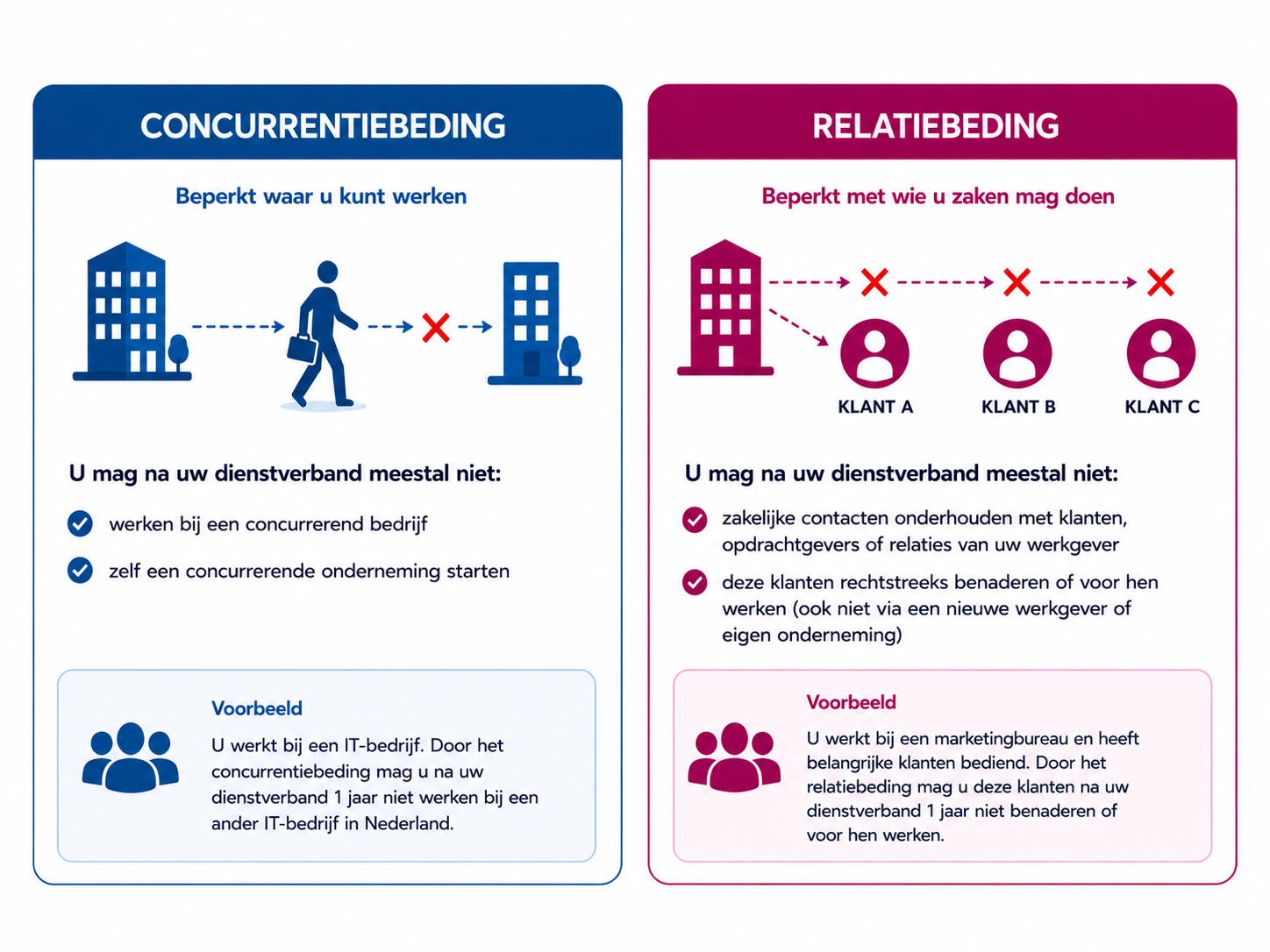
A non-solicitation clause is a provision in your employment contract stating that, following the end of your employment, you may not maintain contact with your employer’s customers, clients or other business contacts. The purpose of such a clause is to prevent these contacts from switching to your new employer or business.
A non-competition clause may, for example, mean that, for a certain period, you are not permitted to carry out work for clients with whom you had contact whilst employed. As a result, a non-competition clause may affect your ability to take up a new job or to continue working as a self-employed person.
What is the difference between a relationship clause and a non-competition clause?
A non-competition clause A non-competition clause and a client non-solicitation clause are similar, but they restrict you in different ways. Under a non-competition clause, you are usually not permitted to work for a competing company or to set up a competing business yourself after your employment has ended. A client non-solicitation clause, on the other hand, focuses specifically on your employer’s customers, clients or business contacts.
When is a relationship clause valid?
A relationship clause is not automatically valid. A number of legal conditions must be met before an employer can hold you to it. For example, the relationship clause must:
- be in writing in your employment contract;
- have been agreed with an adult employee (18+);
- in principle be part of an open-ended employment contract;
- in the case of a fixed-term contract, the reasons must be clearly and specifically stated.
Furthermore, a non-competition clause must not unreasonably restrict your ability to find other work. A court may therefore assess whether the clause is reasonable and whether your employer has a sufficiently compelling interest in enforcing it.
When does a relationship clause expire?
A relationship clause does not always remain valid automatically. In certain situations, the clause may lapse or be declared (partially) invalid. This may be the case, for example, when:
- your role has changed significantly, meaning that the relationship clause has become a greater burden on you;
- the clause unreasonably restricts you from finding other work;
- your employer no longer has a compelling interest in the non-competition clause;
- a court sets aside the relationship clause in whole or in part;
- a valid justification has not been included in a fixed-term contract;
- or whether the agreed term of the relationship clause has expired.
In addition, it is not uncommon for agreements to be reached during a redundancy settlement regarding the waiver or restriction of a non-competition clause. For example, in a settlement agreement.
Relationship clause in a fixed-term contract
In the case of a fixed-term contract, stricter rules apply to non-competition clauses. In principle, an employer may not include a non-competition clause in a fixed-term employment contract, unless there is a clear and compelling reason for doing so (Section 7:653(2) of the Dutch Civil Code).
Your employer must then explain in writing why the non-competition clause is necessary to protect important business interests. Examples include confidential customer information or specific business relationships. A general or standard justification is usually not sufficient.

Non-competition clause for self-employed workers
A non-competition clause may apply if you are self-employed. This is because the non-competition clause does not only apply to work carried out as an employee, but often also to work carried out for clients or business associates of your former employer.
This may mean that, as a self-employed person, you are not permitted to carry out work directly for clients with whom you had contact whilst you were employed. Whether this is actually prohibited depends on the wording of the non-competition clause and the nature of your work.

Relationship clause in the event of dismissal
Whether a non-competition clause remains in force after dismissal depends on how your employment ends and what arrangements are made in that regard. In some situations, the non-competition clause remains fully in force, but there are also cases in which the clause may be restricted or lapse.
Particularly in the case of dismissal by mutual agreement, for example through a settlement agreement, a non-competition clause often forms part of the negotiations. Employers are sometimes willing to relax the clause or waive it altogether, for example if this enables you to find new work more quickly.
You should therefore always seek sound advice before agreeing to be made redundant or signing a settlement agreement.
Can you, and are you allowed to, get round a relationship clause?
Many employees wonder whether they can get round a non-competition clause. The short answer is: no, deliberately trying to get round it is usually not a good idea. Legally speaking, the issue is not about circumventing the clause, but about whether the non-competition clause is valid and exactly how far its scope extends.
What is often possible, however, is:
- negotiate the restriction or removal of the non-competition clause;
- setting out the terms in a settlement agreement;
- have a legal assessment carried out to determine whether the relationship clause is legally valid;
- have it assessed to see whether the clause unreasonably restricts you.
The following is not permitted:
- continuing to actively approach customers or business contacts even though this is prohibited;
- carrying out the same work, albeit indirectly, for your employer’s clients;
- deliberately disregarding a relationship clause without seeking legal advice.
Seek legal advice
Are you unsure whether a relationship clause is valid in your situation, or would you like to know what implications it has for your next step? Our employment lawyer assesses your relationship clause and provides clear advice on your rights, options and any potential risks.




My initial advice is free
I’ll clarify your situation
My name is Robin Sieverdink, an employment lawyer specialising in dismissal cases and settlement agreements. I regularly speak to employees who have doubts about their non-competition clause. For example, because they want to take up a new job or continue working as a self-employed person.
In many cases, it is unclear what is and isn’t permitted. That is why I believe it is important that you first gain a clear understanding of your position. I will carefully assess your employment contract clause and examine both its legal validity and the implications for your work and future plans. You will receive clear and practical advice, tailored to your personal situation.
Would you like to discuss your situation with me? Please call or send a WhatsApp message via +(31) 085-08 054 82 or send an e-mail to info@legalworx.nl.
